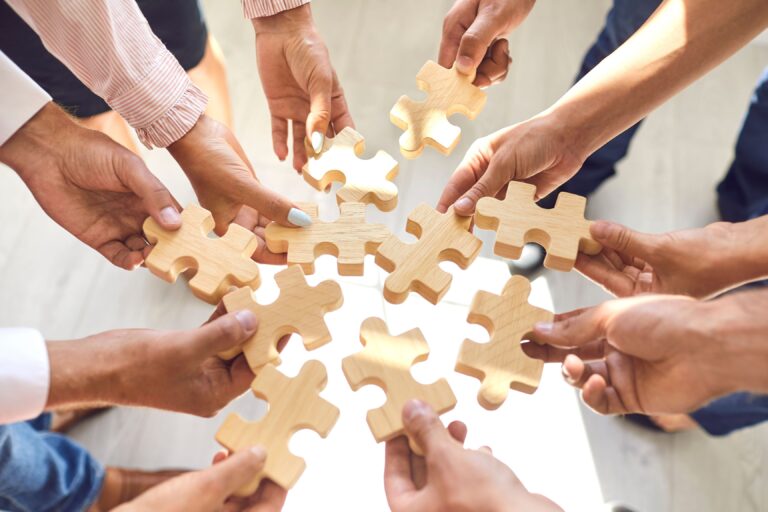


Creating a high-performing team is not just about bringing together individual talents. You are looking for colleagues capable of collaborating effectively, while bringing real added value to your projects. This process often raises questions: how to align skills with objectives? How to establish a positive dynamic while ensuring productivity?
Your needs do not stop there. You want a team that shares your values and understands your priorities, while remaining autonomous in its functioning. Finding this balance may seem complex, but with appropriate strategies, you can build a team capable of meeting your professional challenges. Let us explore together the key steps to achieve this.
Define clear objectives
The first step in building a high-performing team is to establish clear objectives. This allows each member to understand the direction taken by the team and what it must accomplish. Thus, each person knows what their specific responsibilities are.
A well-defined objective serves as a compass and motivates the entire group to focus on collective success. Measuring progress and readjusting the action plan also becomes easier if necessary.
Establish priorities
Our principle of transparency is embedded in our values: saying what needs to be said, even when it is uncomfortable. Concretely, that means we will tell you if your salary range is misaligned with the market. We will tell you if the candidate you absolutely want raises a red flag on a critical point. We will tell you if the training you are requesting will not solve the problem you identify. Everyone says they like transparency; few accept its relational cost. We do.
Once the objectives are determined, it becomes relevant to define clear priorities. Deciding what matters most helps avoid a dispersion of efforts and ensures that resources are allocated efficiently. For example, if a task must be completed quickly, it will receive immediate attention.
Setting intermediate milestones can make objectives less daunting. Each milestone reached will strengthen the team’s motivation and bring them closer to the final goal.
Select the right technical skills and soft skills
Another key aspect of building a good team lies in the careful selection of technical skills and soft skills. Technical skills relate to the specific ability to perform work-related tasks, while soft skills encompass everything related to communication, stress management or the ability to work in a team.
Technical skills: fundamental for certain positions
For certain positions, technical skills are undeniably necessary. A software developer, for example, must master the programming languages required by the project. By having the right technical skills, these professionals can then contribute effectively to the team’s progress.
These skills also enable the resolution of complex problems with expertise, thereby reducing the risk of costly errors.
The importance of soft skills
However, you must not neglect soft skills. Qualities such as communication, empathy and conflict resolution ensure a healthy and collaborative work atmosphere. A team with strong soft skills is better equipped to manage inevitable tensions and maintain high morale.
Therefore, when building a team, considering both technical skills and soft skills proves essential.
Promote organisational fit
Organisational fit means ensuring that each team member adheres to the organisation’s values and culture. Cohesion around these elements strengthens unity and aligns individual behaviours with collective expectations.
To achieve this fit, it is necessary to organise training sessions or team building activities. These initiatives foster mutual understanding and encourage shared commitment to the company’s objectives.
Encourage team autonomy
Fostering team autonomy boosts their efficiency. By giving members the power to make certain decisions, they feel more responsible and concerned about their missions. This autonomy is a source of motivation and often generates remarkable results.
Moreover, well-structured autonomy avoids micromanagers. It allows leaders to focus on strategic tasks rather than on constant control of everyone’s actions.
Organisational support: an invisible pillar
Strong organisational support also plays a crucial role. Colleagues who feel recognition and appreciation for their work tend to show more dedication. This support can take different forms such as encouragement, adequate tools or continuous training.
This favourable climate nurtures trust and stimulates the desire to actively contribute to the team’s successes.
Fair distribution of tasks
To function optimally, a team must respect a fair and balanced distribution of tasks. Everyone must know their roles and responsibilities in order to avoid duplication of efforts and waste of resources.
An equal distribution of workloads ensures that no one feels overwhelmed while others might lack occupation. This also contributes to increased professional satisfaction.
Appropriate delegation
Delegating appropriately facilitates the achievement of objectives. Identifying individual strengths allows each member to shine in their areas of expertise. In this way, talents are used productively, making the entire process more fluid and intuitive.
Adequate delegation also offers personal development opportunities, encouraging the acquisition of new skills within the team.
Efficient direction
Efficient direction is the keystone of successful task distribution. A competent leader knows how to guide their team, provide precise orientations and constructive feedback. This establishes a positive dynamic where collaboration produces tangible gains.
Transparent leadership also inspires trust and promotes a healthy work environment, conducive to innovation and cooperation.
Open communication
Open communication deserves special mention when it comes to building a solid team. Sharing ideas frankly and asking questions without fear facilitate rapid problem resolution and open paths to innovation.
Creating a space where everyone feels heard significantly improves the overall functioning of the team. Transparency reduces misunderstandings and frustrations, two major obstacles to optimal performance.
Frequent feedback
A good communication flow includes regular and constructive feedback. These exchanges help everyone to improve continuously by knowing their strengths and areas for improvement.
Honest feedback sessions strengthen commitment and keep all members aligned with the team’s objectives.
Modern communication tools
To support this open communication, using modern technological tools simplifies daily interactions. Slack, Microsoft Teams, etc., offer platforms to share documents, organise virtual meetings and keep everyone instantly informed.
These tools help maintain constant connection between members, even remotely, fostering better collaboration and synchronicity.
Engagement and team cohesion
Maintaining engagement and team cohesion remains fundamental to ensuring the sustainability of a high-performing group. An engaged team will remain motivated despite obstacles and work together to overcome them.
This cohesion is based on mutual trust, a common objective and respect for individual contributions made. Spending time strengthening these aspects weaves strong and lasting bonds.
Team-building activities
Team-building activities represent tremendous opportunities to strengthen team engagement and cohesion. Sports sessions, collective thinking games or simply dining together, these moments shared outside the strict framework of work strengthen relationships.
These experiences enable the discovery of previously unknown affinities, improving understanding and long-term cooperation.
- Establish clear objectives
- Choose people with complementary technical skills and soft skills
- Ensure organisational fit
- Grant a certain degree of work autonomy
- Maintain open and transparent communication
- Encourage team engagement and cohesion
To go further on our firm.