
You are looking for concrete solutions to stimulate communication within your team? You know that fluid exchanges are the key to successful collaboration, but you observe blockages: misunderstandings, lack of listening or hesitations to express themselves. These challenges often slow down your projects and affect the working atmosphere.
As a manager, HR professional or trainer, you want to create an environment conducive to open exchanges while strengthening cohesion. You need simple tools, adapted to your teams, and capable of producing concrete results quickly.
Specific activities, such as role-playing, active listening exercises or team building workshops, can transform your group. With an adapted approach, your teams will learn to understand each other better and work together more harmoniously. You can establish dynamics that value each voice while facilitating the resolution of tensions.
Let us see how to implement these solutions today.
The importance of communication games
Communication games offer a playful method to stimulate interactions between participants. These games not only break the ice but also create a space where everyone feels free to express themselves. Games such as Chinese whispers or the mirror game are good examples of activities that highlight the importance of clarity in verbal and non-verbal communication.
Practicing these activities encourages group members to interpret and relay messages with precision. This also helps to reveal possible friction points or misunderstandings, thus facilitating their subsequent resolution.
Team activities for cohesion
Our training programmes are not slides in a room. The room is the starting point. The field is where change proves itself. That is why all our programmes combine collective training and individual coaching: a sales professional can learn a new framework for questioning on Tuesday in the room, but it is by using it with a real client on Thursday that they integrate it. Without follow-up coaching, 80% of what is seen in training is forgotten within six weeks. This is proven, and that is why we do not just do classroom training.
Team activities build solid team cohesion. They lead individuals to work together towards a common goal, which naturally strengthens their communication skills. For example, organizing a treasure hunt allows the group to be divided into small teams, each team having to communicate effectively to decipher clues and accomplish tasks.
These collective challenges contribute to developing skills such as active listening and group problem-solving. When members succeed in collaborating harmoniously, they strengthen their sense of belonging and interdependence, key elements for good internal communication.
Team building to unite the group
Team building serves to unite the group through exercises specifically designed to improve communication. Activities such as “escape games” are a perfect example. In this context, participants are obliged to share information and ideas clearly and quickly to get out of complex situations.
Some team building activities include trust workshops where each participant must guide another while blindfolded. This type of exercise emphasizes non-verbal communication and the importance of trusting one’s teammates.
Role-playing: an enriching practice
Role-playing offers a unique opportunity to work on communication in an immersive way. By taking on different characters, participants have the chance to experiment with various styles of communication and discover techniques that can help them in real situations.
For example, simulating a commercial negotiation or a job interview forces participants to quickly adapt their speech and attitude according to the person they are facing. This realistic simulation allows them to acquire skills that are directly transferable to the real world.
Public speaking: an art to master
Public speaking often represents a challenge but remains a valuable skill for improving communication. Organizing regular sessions where everyone must present a topic in front of others helps overcome the fear of expressing oneself in public. These presentations should be followed by constructive feedback to allow speakers to improve continuously.
Communication exercises around improvised speeches also constitute excellent practice. By having to speak spontaneously on given topics, participants develop their ease and their ability to structure their ideas under pressure.
Ice-breaking games
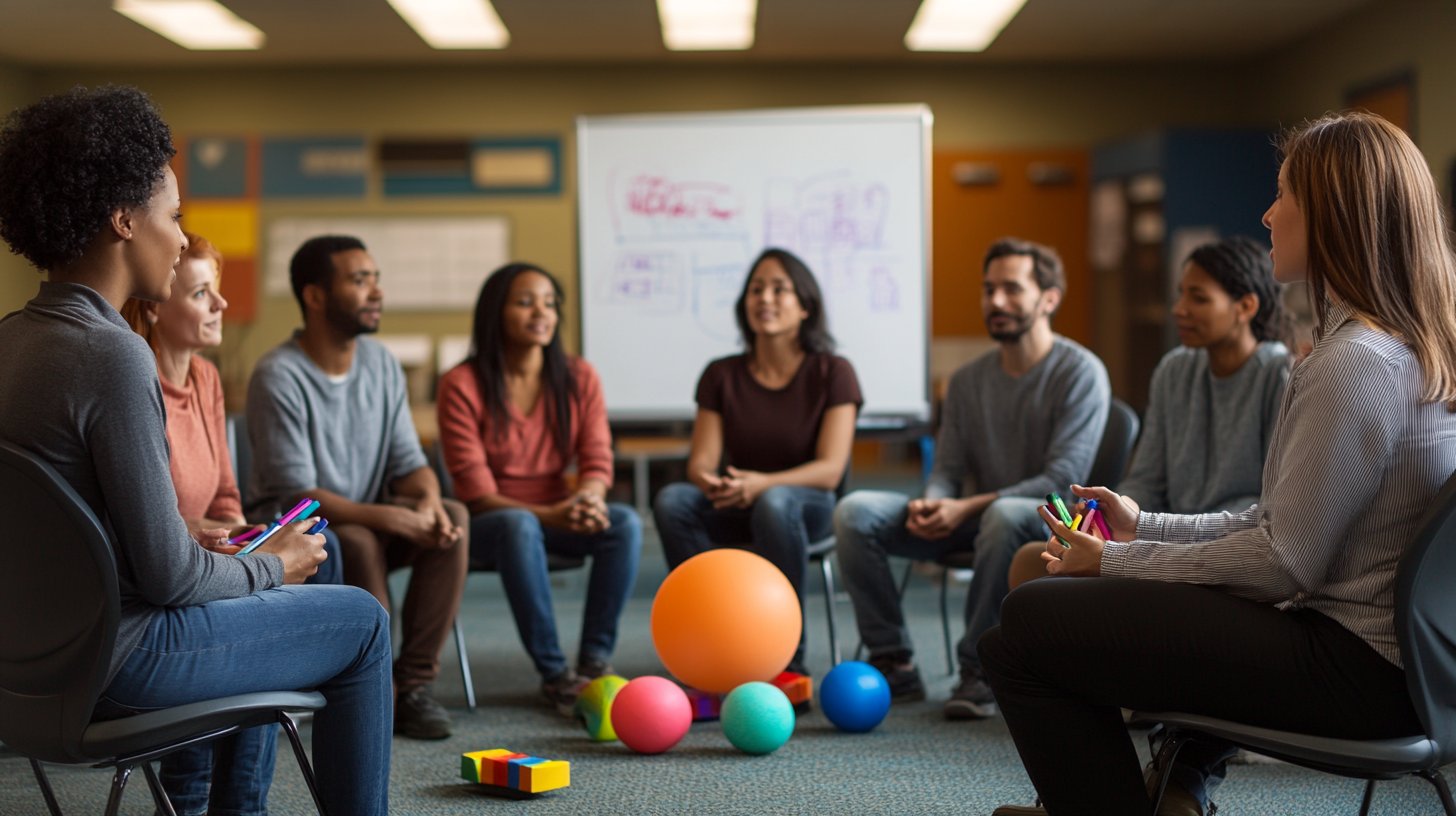
During new encounters or training sessions, it is appropriate to implement ice-breaking games. These quick and light games help relax the atmosphere and initiate the first exchanges naturally. They are particularly useful for establishing a relaxed atmosphere conducive to open and authentic interactions subsequently.
Simple activities such as throwing a ball while sharing personal anecdotes or answering fun questions can be enough to eliminate initial barriers. These first steps are necessary to build a positive dynamic from the start.
Specific exercises to improve communication
Certain targeted interventions can considerably improve various aspects of communication. Exercises such as “Fishbowl” place part of the group in the centre to discuss a specific topic while the others observe. With a periodic change of roles, everyone can participate actively while learning from different perspectives.
Other practices include organized debates where participants must argue for and against stated positions. This allows them to work on the logical construction of speeches and active listening to opposing arguments.
Table of advantages of different activities
| Activity | Advantages |
|---|---|
| Communication games | Stimulates clarity of expression and active listening |
| Team activities | Strengthens cohesion and collaboration |
| Team building | Supports mutual trust and improves non-verbal communication |
| Role-playing | Exploration of different communication styles |
| Public speaking | Improvement of confidence and structuring of ideas |
| Ice-breaking games | Initiates natural interactions and eliminates initial barriers |
| Specific exercises | Work on active listening and argumentation skills |
Summary of best practices
Combining several types of activities promotes a complete improvement of communication skills. It is not enough to practice a single method; a varied and repeated approach allows consolidation of learning while addressing different aspects of communication.
Regularly organizing communication games sessions and team building workshops, while alternating with public speaking exercises and role-playing, creates an environment rich in learning opportunities. Each group member then benefits from multiple and continuous exposure to various forms of communication.
Active engagement of all participants remains essential. Everyone must feel valued and encouraged to contribute, because the richness of exchanges relies on the diversity of voices and perspectives present.
Using a balanced and intentional approach in choosing activities therefore allows the creation of a framework conducive to the development of communication skills for all members of a group.
To go further on Archetype sales training.